
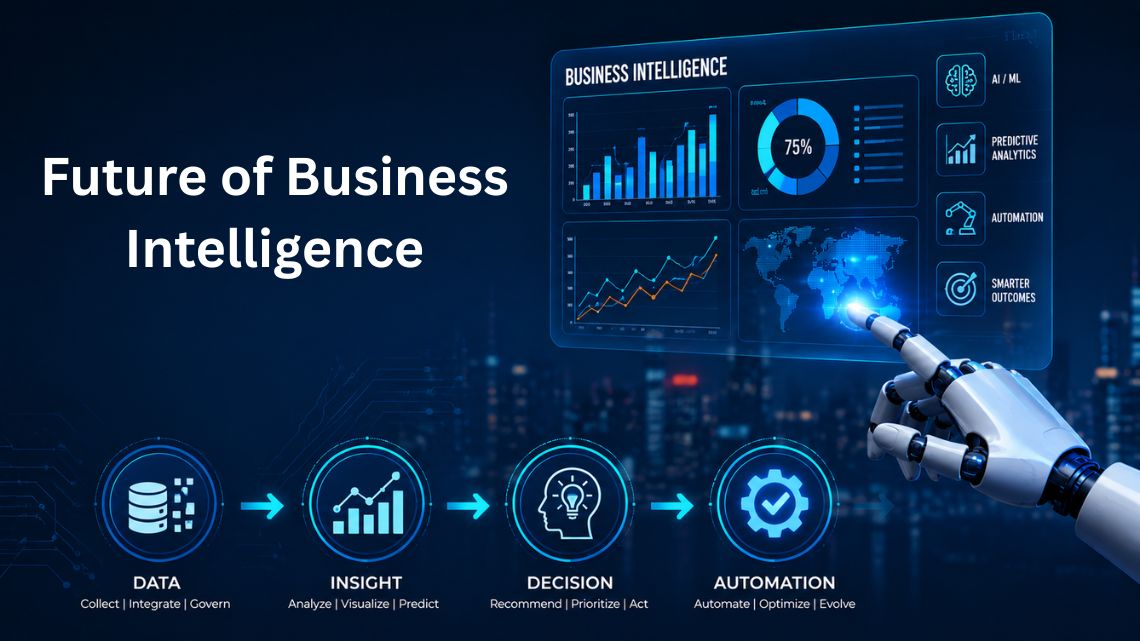
Gulf arena is one of the most forward-looking business giants across the globe. With the Gulf countries moving toward a digital revolution in line with their respective Vision 2030 agendas, expansion of smart cities, industrial diversification initiatives etc. Business intelligence is evolving from the perception of passive reporting to intelligent decision automation. Many enterprises throughout the Gulf Cooperation Council (GCC) are leveraging the advantage of large-scale investments in artificial intelligence (AI), real-time data analytics environments, and predictive intelligence, contributing them to improve efficiency, reduce risk, and provide enable enhanced customer experiences. The future of BI will longer be defined by analysis of historical data but rather facilitating subsequent actions through automation.
Understanding Decision Intelligence and Automation
What Is Decision Automation?
Decision automation refers to the process of using artificial intelligence, predictive analytics and machine learning intelligence to engineer and execute operational decisions without human intervention. The reprocess encompasses casual reasoning to complex scenario modeling and governance frameworks, automating data analysis, pattern recognition and operational actions. This allow businesses to transition from a reactive operational model to agile and intelligent operational transformation.
Difference Between BI and Decision Intelligence
As decision intelligence utilizes predictive and prescriptive capabilities, Albright both BI and DI represents different stages of maturity across data pipelines.
Traditional BI
- Historical reporting
- Static dashboards
- Human interpretation
- Decision Intelligence
Predictive insights
- Real-time
- Intelligence
- AI-assisted
- Recommendations
- Proactive automation
Modern decision automation systems are built on numerous technologies including:
- Artificial Intelligence and Machine Learning utilized for pattern recognition and forecasting
- Real-Time Data Analytics; facilitating instant operational visibility
- Predictive Analytics to anticipate trends and risks
- Workflow Automation to streamline repetitive decisions
- Natural Language Processing (NLP) for conversational analytics
- Unified Data Architectures that centralize enterprise intelligence
By combining therse technologies, organizations can redefine themselves from BI centered on historical data toward future focused decision intelligence as a strategic entrepreneurship capability.
The Evolution of Business Intelligence
- From Dashboards to Conversational AI
The conventional state of BI had been focused on dashboards and reporting; while those BI tools facilitated a comprehensive view into data, automated analysis support independent analysis, reduces analysis time significantly when compared to the manual approaches.
In today’s age, with the emergence of conversational AI, executives can have natural language conversations with analytics systems; therefore, they able to ask business-related questions directly to obtain instant answers and less rely on technical teams to gain insights, leading to accelerated decision making.
- Augmented Analytics
Augmented analytics is a combination of traditional analytics with AI to automatically identify trends and anomalies or opportunities. Rather than organizations manually searching for insight, they receive proactive suggestions and recommendations based on real-time data.
For Gulf Region businesses with large and complex supply chains, this improvement in operational efficiency and agility will have a significant impact.
- From Predictive to Prescriptive Decision Automation
Predictive analytics in B2B marketing allows users to forecast future functionality while prescriptive analytics uses predictive information to suggest an action.
For example, a predictive system could identify a supply chain disruption while a prescriptive system could automatically update procurement or logistics processes to minimize the effect of the supply chain disruption .
The movement from providing insight to expediting decisions via intelligent execution will shape the future of enterprise operations.
- Decision Engineering and Governance
As automated decision systems gain more traction, it becomes increasingly important to enable a governance structure in place. Organizations must ensure:
- Accurate data
- Regulatory compliance
- Ethical AI use
- Human accountability
- Overseeing risks
Strong governance platforms will be essential for long-term sustainable AI use throughout the Gulf Region’s highly regulated industries, such as healthcare and banking.
How Decision Automation Is Transforming Industries
Finance and Banking
Decision automation is being implemented by banks throughout the Gulf region in order to:
- Fraud detection
- Real-time risk assessment
- Automated compliance with regulations
- AI-driven forecasting.
Decision automation provides banks with the ability to increase operational resilience while providing a superior customer experience.
Healthcare
Healthcare providers are utilizing AI powered intelligence for the following functions:
- Predictive diagnostics
- Resource optimization
- Patient engagement
- Operational forecasting.
Automated decision intelligence enables the healthcare providers achieve both efficiency as well as improve care effectiveness.
Retail and E-Commerce
Decision automation for retail organizations allows for:
- Personalized customer experiences
- Demand forecasting
- Dynamic pricing
- Intelligent inventory management.
As the retail sector in the Gulf become increasingly competitive, algorithmic driven dynamic pricing, hyper personalized recommendation based on data will become the key differentiator for business management .
Manufacturing and Supply Chain
Manufacturers are harnessing advantages of decision automation to improve:
- Predictive maintenance
- Logistics optimization
- Supply chain visibility
- Inventory forecasting.
These capabilities will be essential to the ongoing evolution of the manufacturing industry in the Gulf as the economies of Gulf nations continue to diversify into industrialization and smart manufacturing initiatives.
The Shift from Human-Led to Human-Augmented Decision Making
With the rapid growth of artificial intelligence lately, business intelligence has the potential to continue human centric while preventing systemic bias of AI automation. Although AI can improve speed, scalability and analytical accuracy, executive leaders must achieve proficiency adopting and combining emerging technology skills as well as strategic thinking, ethical judgment, and situational context to provide direction and drive organizational effectiveness. While machine provides competencies such as data processing, automating repetitive tasks, and analysis human intelligence on the other hand help leaders create an organization by promoting long-term vision, innovation and aligning the everyone on adopts these efficiencies concurrently to strategy. Therefore, successful organizations will combine machine intelligence with human skills in order to enhance the speed, decision accuracy and resilience of business intelligence models.
For more articles, visit Entrepreneur Gulf.
Connect with Us:
LinkedIn: https://www.linkedin.com/company/entrepreneur-gulf/
Twitter X: https://x.com/entpre_gulf
Instagram: https://www.instagram.com/entrepreneurgulf/