
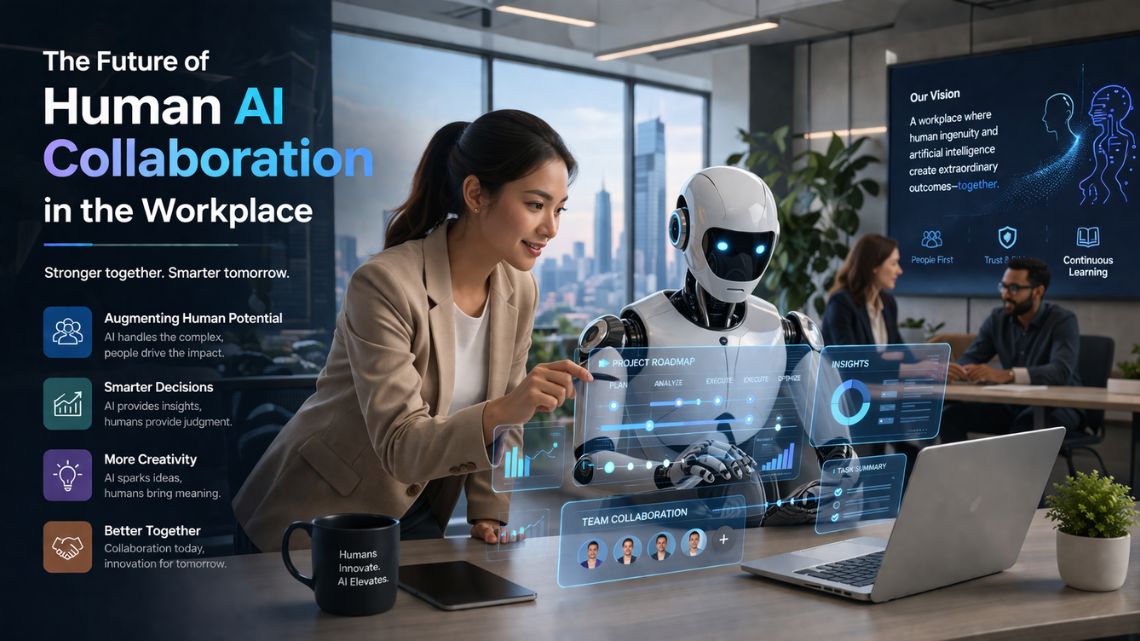
The integration of AI in the realm of business is transforming from solely a back-office automation tool to a strategic partner. Across the Gulf landscape, this shift marks a critical inflation point, compelling organizations to pivot from the perspective of human-AI collaboration as an option to considering it as a requirement for evolving competitiveness. In lieu of overemphasizing on AI-driven job displacement, modern organizations embrace augmentation and Human-AI collaboration for accelerating value creation, cultivating high-performing and future-ready workplaces.
What is Human-AI Collaboration
The concept of Human-AI collaboration refers to an interactive partnership between humans and artificial intelligence systems concurrently to establish optimized workflows that neither could accomplish independently. It cannot be defined as solely a substitution model, as human abilities such as judgement, creativity and contextual understanding have strong influence on scale, speed and analytical precision of AI.
In this contemporary era, where workplaces have transitioned with progressive shifts, early AI implementations are one of the crucial differentiators for industry leading organizations. Machine intelligence was broadly being leveraged beyond automation of repetitive tasks to and augmenting human efficiency.
The concept was historically introduced as a means of assisted intelligence—automated data entry, spreadsheets, such basic tasks. With the transition toward AI in leadership as a copilot, organizations are able to accelerate decision intelligence with real time data insights, predict challenges ahead and become proactive and agile. In the era of Human and AI as collaborators, offering a wide spectrum of possibilities such as content generation, complex sequences of task automations, and serves as a partner for activities such as brainstorming.
At its core, human–AI collaboration is defined by three key concepts:
Complementarity: Using both Human and AI strengths
Interaction: feedback loops between human input and AI output
Adaptability: systems that learn and evolve alongside human users
The Strategic Value of Human–AI Synergy
- Enhancing productivity and operational efficiency
Human and AI intersection can increase productivity by automating routine tasks, therefore employees can allocate their time into more higher-value initiatives. Catalyzing execution, reduced operational bottlenecks, such strengths are integral competitiveness in today’s operational ecosystem.
- Improving decision-making
The ability of AI systems to analyze large amounts of data, identify leading trends, such capabilities contributes to enhanced quality decisions. When a human integrates judgement and context to an AI-generated decision, organizations can make better, faster, more strategic decisions.
- Accelerated Innovation
Innovation is less time-efficient when managed solely by human effort than it does when a human and an AI collaborate. AI helps generate new ideas, create new operational models and design scalable solutions. Humans on the other hand, help improve the creative process and identify where to innovate strategically.
- Creating scalable, agile business models
The use of AI-based systems enables businesses to operate at a higher scale without significantly increasing costs or time to value. This allows companies to leverage AI to establish agile business models that can respond to, and capitalize on the changes and opportunities in the market rapidly.
- Competitive differentiation
Businesses when strategically incorporate AI in workplace architecture will achieve resilience over their competitors. They are likely to become more productive, innovate faster and generate better value to customers and stakeholders.
Core Models of Collaboration
- Human-in-the-loop
In this, AI systems operate under human feedback and performance validation. The purpose of having humans as a part of the process is to ensure accuracy, accountability, and reliability of AI results, especially in scenarios where there is a high level of risk or regulation involved.
- Human-on-the-loop
AI systems facilitate greater degree of independence, however, humans supervise monitoring the performance of and intervening if necessary. This model offers a proficiency to scale operations through AI automation, while maintaining control and oversight over the AI system, ensuring synchronicity between efficiency and oversight.
- Human-and-AI co-creation
In this collaboration model, humans and AI work in tandem to develop ground breaking solutions. As a result, it enables organizations to rectify bottlenecks, drive innovation and demonstrate more sophisticated outcomes that were unattainable through independent effort.
How Human AI Collaboration Redefining the Workplace
- Augmentation Over Replacement
The nature of the distinction between replacing humans with artificial intelligence versus augmenting human capabilities using artificial intelligence is rapidly changing with collaborative models which combine human productivity and creativity with AI intelligence.
- Rise of Hybrid Teams
Organizations are evolving from in office workforce models to hybrid teams where both humans and artificial intelligence work cooperatively. This new form of workforce will require new management styles, goal specific metrics for measuring team performance, and new avenues of collaboration techniques.
- Demand for New Skills
With the increased integration of artificial intelligence into daily business workflows, it presents the requirement of industry demanding skill sets and practical acumen. Talent forces are necessitated to become fluent in capitalizing on digital possibilities, and operate alongside new systems.
- Ethical and Responsible AI Use
The unprecedented reliance on AI also imposes responsible usage practices. Organizations are compelled to establish stringent governance frameworks, transparency, fair and accountable approach across deployment and usage. This contributes to long term sustainability and trust in organizational frameworks.
Conclusion
Organizations are currently redefining competitive positioning through leveraging humans-AI collaboration as a strategic currency. For businesses in the Gulf region, this represents an opportunity for improved productivity, more intelligent decision-making and scalable growth. The measure of success will depend upon the integration of AI with human capabilities in an ethical manner and converge it with clear strategic alignment. By deploying such models with intention, organizations can excel beyond leading change and will therefore position themselves for long-term relevance within the context of a rapidly evolving and digitally interconnected business environment.
For more articles, visit Entrepreneur Gulf.
Connect with Us:
LinkedIn: https://www.linkedin.com/company/entrepreneur-gulf/
Twitter X: https://x.com/entpre_gulf
Instagram: https://www.instagram.com/entrepreneurgulf/