
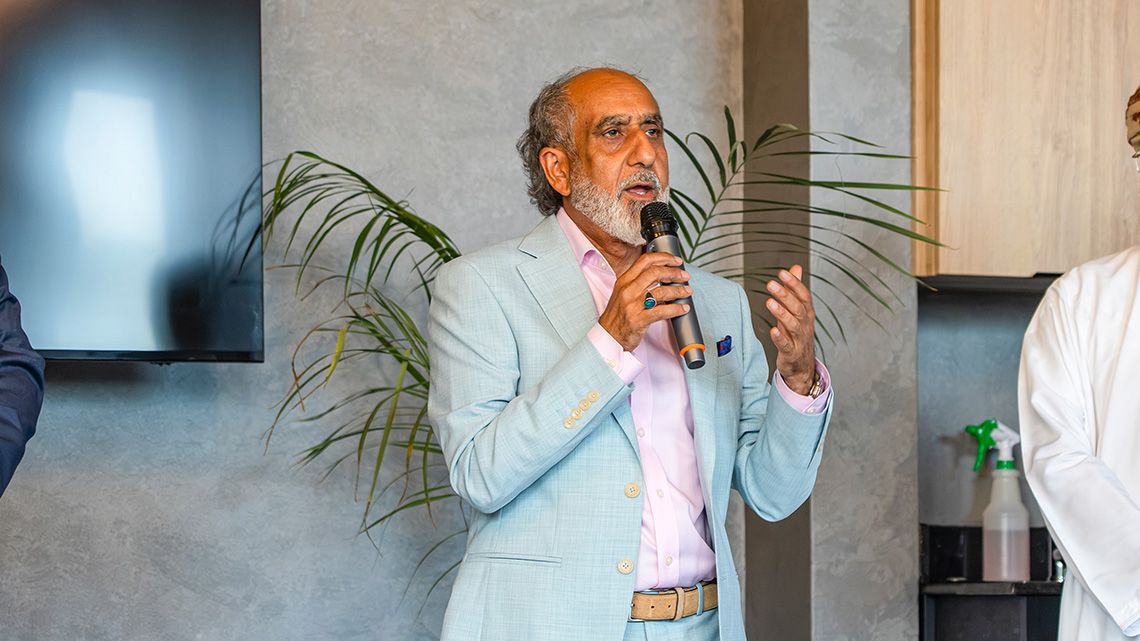
Wa’qar Mirzadah, CEO of Al Yaqeen Reality
After four decades in banking, investment, property and media, Wa’qar Mirzadah has arrived at a simple but ambitious conclusion: business should exist to help people thrive rather than merely generate profit. His work today spans ethical property development, home finance, filmmaking, publishing and investment, all connected by what he describes as the Ethical Value Ecosystem (EVE), a framework designed to align capital, culture and conscience.
Mirzadah’s professional journey began in senior roles at PwC, British Telecom and HSBC, where he raised and deployed capital across sectors including property, education, consumer products and energy. Those experiences gave him valuable commercial insight but also revealed what he believes is a deeper flaw in many modern economic systems.
He argues that many industries continue to reward short-term financial gains while overlooking long-term social and environmental consequences. Rather than accepting those models, he chose to pursue an alternative approach centred on ethical leadership, sustainable value and human dignity.
A pivotal turning point came while filming a documentary on preventable blindness. During production, Mirzadah witnessed a mother seeing her daughter for the first time in sixteen years after receiving an inexpensive medical procedure. The treatment had always been available, but the woman had been unable to afford the journey to access it.
For Mirzadah, the experience highlighted the distance that often exists between commercial success and human need. It also inspired him to write EVA, a thriller exploring the consequences of corporate greed and systemic neglect. The project reinforced his conviction that storytelling, investment and infrastructure are closely connected, with each influencing how societies develop.
Today, that philosophy underpins his diverse ventures. Through a UK-based ethical innovation platform, he supports purpose-driven businesses and cultural initiatives. Through Al Yaqeen Reality, he focuses on creating communities designed around wellbeing rather than speculative development. Alongside this, he has developed a new approach to home finance intended to improve fairness, accessibility and long-term stability.
At the heart of each venture lies a recurring question: what would systems look like if they were designed to help people flourish instead of simply survive?
Reimagining Property Development
Al Yaqeen Reality, yes, reality, was founded in response to what Mirzadah considers one of the greatest shortcomings of conventional real estate development.
Having spent decades financing and investing in property markets, he became increasingly concerned that many developments prioritised density, luxury branding and investor returns while paying insufficient attention to the people who would ultimately live there.
He believes too many projects overlook mental wellbeing, family life, community interaction and environmental responsibility. Rather than treating these as optional extras, Al Yaqeen Reality seeks to place them at the centre of every development.
Mirzadah selected Salalah in Oman as the company’s base because of its natural beauty, climate and cultural character. He believes the city offers a unique opportunity to demonstrate how modern development can respect local heritage while embracing international standards of design and sustainability.
The company is developing projects that combine wellness, longevity, environmental responsibility and family living. Planned developments include branded residences and beach communities designed to encourage healthier lifestyles while celebrating Oman’s identity rather than importing generic architectural styles.
Mirzadah sees this not as philanthropy but as a commercially sustainable model capable of delivering long-term returns alongside lasting social value.
Designing Communities Around People
For Mirzadah, sustainability begins long before construction starts.
Instead of focusing first on financial models or land values, Al Yaqeen Reality begins each project by considering how residents will experience the space decades into the future. Questions of psychological wellbeing, safety, social interaction and environmental resilience are treated as core design principles rather than marketing features.
This philosophy influences every aspect of development, from environmentally responsible building materials to advanced water conservation systems suited to Oman’s climate. Landscaping is designed to reduce heat while strengthening residents’ connection with nature.
Perhaps most distinctive is the emphasis on community interaction. Developments deliberately sacrifice some building density to create pedestrian routes, green spaces and communal areas where neighbours naturally meet. The aim is to reduce the isolation that increasingly characterises modern urban life while encouraging stronger family and community relationships.
Mirzadah believes developments designed around human wellbeing ultimately produce stronger long-term commercial outcomes because they create places where people genuinely want to live.
Challenging Established Systems
Launching ventures built on ethical principles was not without obstacles.
Mirzadah says the greatest challenge was not raising finance or recruiting talent but overcoming institutional resistance. Many investors, accustomed to measuring success through short-term financial performance, initially viewed sustainability and community-centred development as commercially unrealistic.
Developing a new home finance model also required navigating regulatory systems designed around established banking practices. Remaining committed to his principles often meant slower growth and declining opportunities that conflicted with the company’s long-term vision.
Over time, however, he believes results have begun to change perceptions. Developments designed around quality of life have attracted growing interest, while investors who once dismissed the model are increasingly seeking to understand its commercial performance.
For Mirzadah, the experience reinforced an important lesson: meaningful innovation often faces scepticism before it gains acceptance.
Creativity as Leadership
Although Mirzadah is widely known for his business interests, he sees filmmaking and writing as central to his leadership philosophy rather than separate creative pursuits.
His documentaries, children’s series Zayn and Zayna’s Little Farm and novel EVA all explore themes of empathy, justice and social responsibility. He believes storytelling allows leaders to understand perspectives often ignored by traditional commercial systems.
That creative discipline influences the way he leads organisations. Rather than relying on hierarchy alone, he aims to create environments where people are inspired by shared purpose.
His work on charitable boards, including the Royal Voluntary Service, together with leadership roles in African investment, has further strengthened his belief that protecting human dignity should be viewed as a core business responsibility rather than simply corporate social responsibility.
Mirzadah often returns to a guiding principle: societies prosper when success is matched by responsibility.
Looking Ahead
Mirzadah’s long-term ambition is to establish Al Yaqeen Reality as a global benchmark for ethical, wellness-focused property development, beginning in the GCC.
Current plans include carbon-neutral communities, longevity-focused coastal developments, a championship golf course, a boarding school, an equestrian centre and projects linking health, renewable energy and sustainable agriculture in Salalah. The wider EVE framework also encompasses investments in solar energy, hydrogen and responsible finance.
Beyond individual developments, he hopes to demonstrate that ethical business can become a competitive advantage rather than a commercial compromise. He also aims to challenge outdated perceptions of the Muslim world and the Global South by showcasing innovation rooted in cultural identity and responsible leadership; no one has ever become by giving.
Ultimately, Mirzadah measures success not by personal wealth but by lasting impact. He aspires to leave behind systems that continue improving lives long after their founders have stepped away.
Advice for the Next Generation
Mirzadah encourages emerging entrepreneurs across Oman, the GCC and other developing markets to resist simply copying established business models.
He believes future leaders must combine commercial discipline with ethical conviction, identifying structural problems and creating enterprises that repair rather than exploit them. New ideas, he argues, will almost always encounter resistance, but genuine innovation rarely emerges without challenging accepted norms.
He also urges young leaders to protect their creativity and develop strong storytelling skills, viewing narrative as a strategic tool capable of shaping industries as powerfully as finance or technology.
On a personal level, Mirzadah says much of his motivation comes from thinking about future generations, particularly his grandchildren. The question that drives his work is simple: what kind of world will they inherit?
For him, that responsibility extends beyond business performance. It means creating communities, institutions and economic systems that are kinder, more sustainable and centred on families.
As the GCC enters a period of significant transformation, Mirzadah believes the region has a rare opportunity to define a new model of development, one that combines profitability with purpose and demonstrates that long-term prosperity is built by helping others flourish.
His vision is straightforward but ambitious: build systems that leave no one behind, because the most enduring legacy is not wealth itself but the positive impact it creates.