
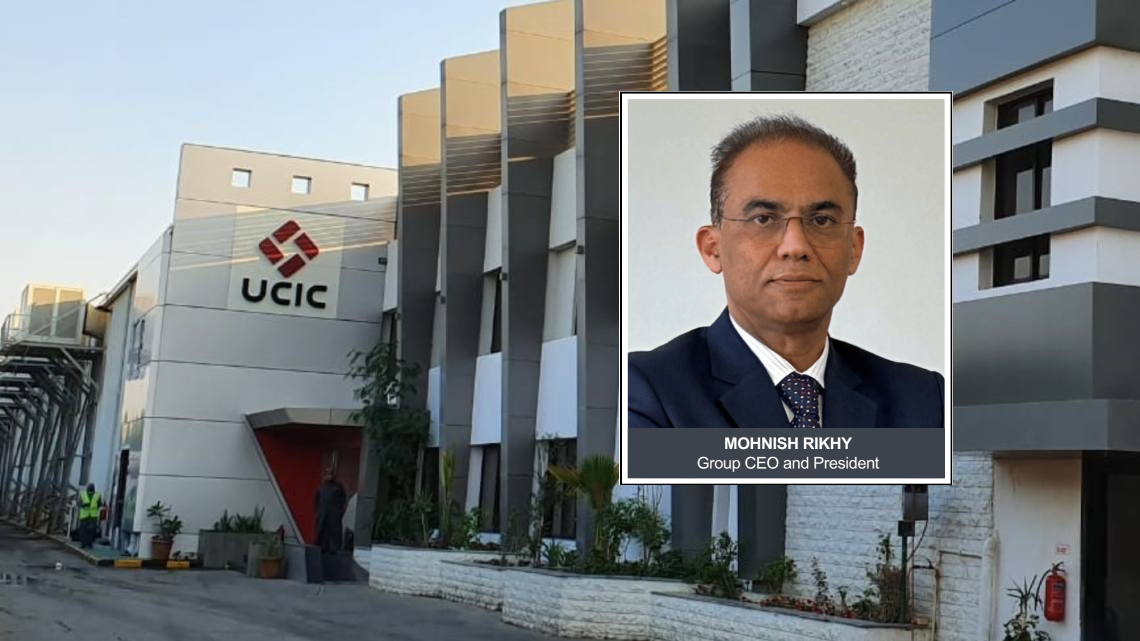
In Conversation with Mohnish Rikhy
Packaging sits at the intersection of product, brand, and supply chain. A carton must protect what it carries, perform through transport and handling, and increasingly communicate a brand’s identity while meeting tougher demands for efficiency and sustainability. At United Carton Industries Company (UCIC), these demands have shaped a business that looks beyond the box itself, building its capabilities around changing customer expectations and a market that is becoming more exacting by the day. Under the leadership of Group CEO and President Mohnish Rikhy, that evolution has been guided by a balance of scale, innovation, customer focus, and human values.
From One Plant to a Regional Footprint
UCIC’s story is one of those rare growth journeys where scale has followed ambition, not driven it. What began with a single greenfield corrugated plant in Jeddah in 1991 has evolved into a regional packaging enterprise with eight manufacturing facilities across Saudi Arabia and the UAE, an annual production capacity of approximately 500,000 tons, and a portfolio spanning corrugated packaging, containerboard, folding carton, and pulp products. With annual revenue of approximately $400 million, the business has built its weight through a steady accumulation of capabilities rather than a single leap.
UCIC maintains its leadership position in the Kingdom’s corrugated market, commanding a market share of approximately 37% to 40%. Its expansion has unfolded in measured chapters: a second Jeddah plant in 2001, Riyadh facilities in 2007 and 2015, a best-in-class greenfield facility in Al Kharj in 2018, entry into folding cartons through the acquisition of an Eastern Province plant in 2022, and a move upstream into containerboard through the acquisition of a Jebel Ali, Dubai mill in 2023. A further corrugated packaging acquisition in the UAE followed in 2024, before UCIC successfully listed on Tadawul in 2025.
But the chronology only tells part of the story. Alongside physical expansion, UCIC has steadily widened what it can offer, introducing the GCC’s first single-pass digital printing machine for corrugated packaging and developing a customer portal through which around 75% of orders are now processed. “Our growth has never simply been about adding capacity; it has been about building a business that stays close to the customer,” reflects Rikhy. Headquartered in Jeddah, UCIC now serves customers across FMCG, industrial, pharmaceutical, and other sectors, with a regional footprint designed to be both broad and interconnected.
When the Box Became Part of the Brand
The humble carton has acquired a more complicated job. It still has to protect what is inside, but increasingly it must also communicate what is inside, survive the rigours of modern logistics, catch the eye on a retail shelf, and answer growing expectations around efficiency and sustainability. Packaging has become, in many cases, a brand’s first physical handshake with its customer. That shift has shaped UCIC’s approach. Its solutions span shelf-ready packaging, e-commerce formats, and high-impact point-of-sale displays, bringing functionality and visual appeal into the same frame. Advanced printing has pushed that proposition further. The GCC’s first single-pass digital printing press for corrugated packaging allows high-quality graphics, personalisation, shorter production runs, and faster movement from concept to market. “Packaging should work as hard for the brand as it does for the product,” shares Rikhy.
Yet market sophistication brings its own pressures. Geopolitical developments and changing customer behaviour have compressed the margin for error, while customers increasingly expect shorter lead times, greater customisation, sustainability, and cost competitiveness without giving quality any ground. For UCIC, maintaining consistency across an expanding manufacturing network has meant standardising processes, quality systems, and performance metrics while continuing to invest in automation, technology, talent, leadership, and digital capabilities. Supply-chain volatility has added another layer to the equation. UCIC has responded by diversifying its containerboard sourcing across local suppliers and partners spanning multiple continents, reducing dependence on any single source or geography. The objective is straightforward: remain dependable when circumstances are not.
The Intelligence Behind the Carton
The next chapter of packaging is being written as much in data and algorithms as it is in paper and ink. UCIC’s customers include leading names across domestic and international FMCG, durables, and industrial sectors, placing the company against global benchmarks rather than merely local ones. Technology, therefore, has become less of a showcase and more of an operating discipline.
Its investments in high-graphic printing and single-pass digital printing have created greater flexibility for customers, while its digital customer portal has changed how business moves beyond the factory floor. Customers can place orders, approve artwork, access invoices and delivery documents, and track shipments in real time. Around 75% of orders now come through the platform, a measure not only of digital adoption, but of how far the company has taken the friction out of doing business. The next frontier is AI. UCIC’s virtual assistant, Boxy, provides 24/7 customer support, while wider AI initiatives are being applied across customer service, operations, and safety to strengthen efficiency and decision-making. “Technology matters when it makes the customer’s life easier,” says Rikhy.
The same instinct toward practical innovation informs UCIC’s sustainability agenda. Sustainability, in its view, is no longer a corporate ornament; it is an obligation to leave a more liveable world for those who come next. Paper-based packaging offers a natural advantage through biodegradability, while UCIC’s own operations reinforce the principles of the circular economy. More than 80% of the paper it uses comes from recycled fibre, its UAE containerboard mill produces 100% recycled paper, and 98% of production waste from box manufacturing is automatically collected and returned for recycling. Wastewater treatment plants conserve thousands of litres of water every day, while UCIC is gathering Scope 3 emissions data to identify further opportunities to reduce its carbon footprint. The ambition is not to treat environmental responsibility and operational performance as competing agendas, but to make them pull in the same direction.
What Holds the Whole Together
The scale is visible. What sustains it is less so. At UCIC, people, processes, and technology are treated not as separate pillars but as parts of the same operating system. Its people remain the foundation, with continued investment in technical, operational, and leadership development to ensure that the workforce evolves alongside the business. Automation and AI may change how work is done, but they do not displace the company’s belief in human judgement and connection.
Processes provide discipline. Standardised operating procedures, robust quality systems, and data-driven decision-making help maintain consistency across eight manufacturing facilities and a customer base spanning FMCG, industrial, retail, e-commerce, and other sectors. Technology then adds reach and precision through state-of-the-art manufacturing equipment, automation, digital printing, ERP integration, and customer-facing platforms. “Technology can strengthen the way we work, but the human touch will always remain fundamental,” says Rikhy. That human-centred approach also extends to resilience. With facilities strategically positioned across Saudi Arabia and the UAE, UCIC can draw on alternate production sites when demand surges or unexpected disruptions arise, giving customers another layer of supply security.
Looking ahead, the company intends to expand geographically and across complementary packaging segments through a balanced combination of organic investment and strategic acquisitions. Digital transformation and AI will remain central, as will supply-chain diversification, local sourcing, backward integration, sustainability, and the development of future-ready talent through UCIC’s Skill Development Centre. The ambition extends beyond making cartons. UCIC wants to build a business capable of growing without losing its footing, innovating without losing its purpose, and expanding without losing sight of the people who make the whole enterprise work.
The Lessons That Travel With the Business
Rikhy’s leadership outlook has been shaped by lessons gathered across industries, relationships, and different stages of his career. His career reads less like a straight line and more like a collection of lessons gathered along the way. Nestlé taught him the hunger for growth; Unilever, the value of partnership; Pepsi, the instinct for competitiveness; and finally, UCIC, something more fundamental, the human values behind an organisation. The foundations established by UCIC’s parent shareholders, Zamil Group, Omar Kassem Alesayi & Company, and Frimex Investment LLC, have likewise played an important role in shaping the organisation and his journey. “UCIC is built on teamwork. I am truly blessed to have a management team that has always stood beside me, we work not just as a team, but as a family. I am also deeply grateful to our Board and Chairman, Mr. Adib AlZamil, for their continuous guidance and support throughout my journey. This is a blessing few CEOs get to experience,” reflects Rikhy.
Those experiences have been distilled into a leadership philosophy that favours consistency over intensity, implementation over intention, and simplicity over jargon. Rikhy believes contradictions must be managed alongside uncertainty, that solutions should first be sought within the box before looking outside it, and that leaders should behave like leaders rather than bosses. He places attitude alongside competency, EQ above IQ, and believes the ability to bend becomes increasingly important as one grows. There is pragmatism in that philosophy, but also a certain humility. Success, in his view, is sustained through consistency; intentions matter only when they survive the difficult journey into implementation. Complexity should not be mistaken for sophistication, and arguments matter less than changing minds toward a shared objective.
“We should discuss to win the mindset, not the argument,” Rikhy states. Perhaps the most revealing measure of that philosophy lies outside conventional business metrics. UCIC continues to engage with and support its retired employees, maintaining a relationship beyond working life and recognising that an organisation’s character is often most visible in how it treats the people who helped build it. For a company whose business is built around holding things together, there is an aptness to that final measure.
UCIC has spent more than three decades building capacity, capabilities, and connections; its next chapter will be defined by how well it holds those pieces together while the world around it changes shape.