
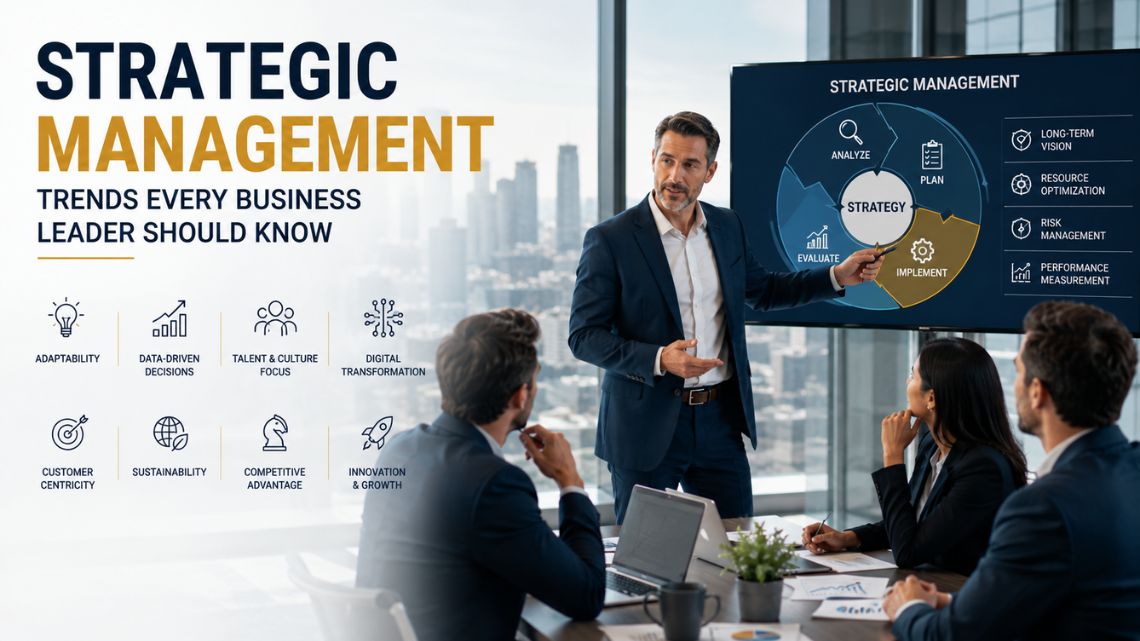
The GCC landscape is witnessing a paradigm shift, as nations diversify beyond oil to technology, innovation and renewable energy, refining corporate governance mandates, and competitive requirements, management resilience has become a crucial element for engineering economic transformation. Managerial authorities must architect a synchronized approach between localization adhering to the national agendas and the adoption of global trends in business. In order to flourish in a highly saturated market like the Gulf, strategic management aimed at sustainability, and long term relevance is ultimately the currency.
Key Strategic Management Trends in the Gulf Region
- Vision-Driven Corporate Strategy Alignment
In the Gulf landscape, the primary enabler shaping corporate strategy is the sovereign vision alignment as a long term imperative. With the part of national development agendas, the governments are significantly investing in private enterprises for accelerating economic direction, infrastructural support and facilitating entrepreneurship friendly regulatory policies. These advantages help Gulf based enterprises develop vision and policy supported business management styles.
Integrating national priorities in management is no longer an option, but a critical to expand across sectors like energy transition, digital economy, and infrastructural evolutions.
- Digital-First Strategic Transformation
With digital transformation agendas, the GCC has achieved a remarkable paradox: One of the world’s youngest digital infrastructures operates within some of the region’s most traditional institutional systems. The businesses in this region have moved from an operational upgrade to a core strategic pillar by redefining smart infrastructure, artificial intelligence, and digital governance systems.
Prominent areas such as Dubai and Riyadh are emerging into global digital hubs through the government’s initiative including smart city development and AI-driven public services. Also, digital such changes manifested as organizational empowerments toward cloud-native systems, data-driven decision-making, and automation transcending the legacy infrastructure configurations.
- ESG and Sustainability as Strategic Imperatives
In today’s increasingly conscious consumer environment, ESG goals have become a non-negotiable strategic pillar for business management success. Government ambitions such as UAE’s net-zero 2050 commitment, Saudi Green initiative targeting 278 million tree plantations, Qatar’s pledge to achieve carbon neutrality etc. are making a sustainable model of economic stewardship. Critically, managers consider social value creation with responsibility and governance, it can translate into enhanced reputation, stakeholder interest and increased investment.
- Rise of Sovereign Wealth Fund Influence
Sovereign wealth funds—Abu Dhabi Investment Authority (ADIA), Saudi Arabia (PIF), Qatar Investment Authority (QIA), Kuwait Investment Authority (KIA)—and diversification of oil strongly influence net economic growth across the regional landscapes.
These investments simultaneously serve as competitive entitlement and regulatory support rather than solely for commercial developments.
- Workforce Nationalization and Talent Strategy
Government initiatives on worker participation, across the gulf states, include emirates, saudi and oman, their respective national workforces within both the public sector and private sector. In addition, business organisations must also have access to global talent, especially in areas of specialised expertise—artificial intelligence (AI), cybersecurity, advanced engineering—these global talent access strategies are emerging as one of the chief focus areas for leadership’s strategic workforce planning.
- Agile and Resilient Business Models
The shifting dynamics of the global economy, geopolitical forces and transition to new forms of energy have increased the need for flexibility in business operating models. Many organisations are utilising operating models that allow for faster decision-making, and developing strategies for scenario planning as a way to increase the flexibility of management functions.
- Innovation Ecosystems and Startup Growth
The Gulf region is rapidly creating Innovation Ecosystems that are being facilitated through organisations, such as Free Zones, Incubators and Government-Sponsored Programs. The Dubai International Financial Centre and the Abu Dhabi Global Market are serving as financial hubs to enable the growth of startups in such areas as Fintech, Proptech, and AI generated services.
With this Innovation Ecosystems, the Gulf is positioning itself as a global hub for Entrepreneurship and Venture Capital Activities.
Strategic Challenges Facing Gulf Business Leaders
- Talent Shortages in Specialized Fields
Although enterprises facilitate considerable investments in employee education and training, the rapid sectoral diversification has compelled highly qualified talent pools in fields such as artificial intelligence, data science, and advanced engineering, contributing to compensation inflation as well as structural instability.
- Balancing Globalization with Localization
While the rising pressures to access global markets, opportunities and technological ecosystems, the localization mandates such as benchmarks of procurements, employment and content requirements creates a complex managerial environment.
- Regulatory Complexity Across GCC Markets
Even with the increased integration aspirations within the GCC region, there remains challenges of a distinct regulatory framework across the countries, thus requiring companies to adapt their business strategies that aligns to different regulatory frameworks.
Conclusion
Strategic management is predominantly achieved through optimized integration of digital technology, workforce localization, and national economic visions. Organizations that embrace global competitiveness and national ambitions while maintaining agility, innovation, and internal alignment will become industry frontiers in the Gulf’s ever evolving economy.
From vision aligned strategic frameworks and ESG imperatives to Sovereign wealth funds, innovative ecosystems to geopolitical realignment, executive managers can develop incomparable transformations. It is integral to achieve a digital first strategic architecture for effectively navigating the continuously evolving compliance requirements. When leaders understand and leverage the current strategic trends, it rewards intellectual rigour, institutional sophistication and efficiency to define future standards.
For more articles, visit Entrepreneur Gulf.
Connect with Us:
LinkedIn: https://www.linkedin.com/company/entrepreneur-gulf/
Twitter X: https://x.com/entpre_gulf
Instagram: https://www.instagram.com/entrepreneurgulf/