
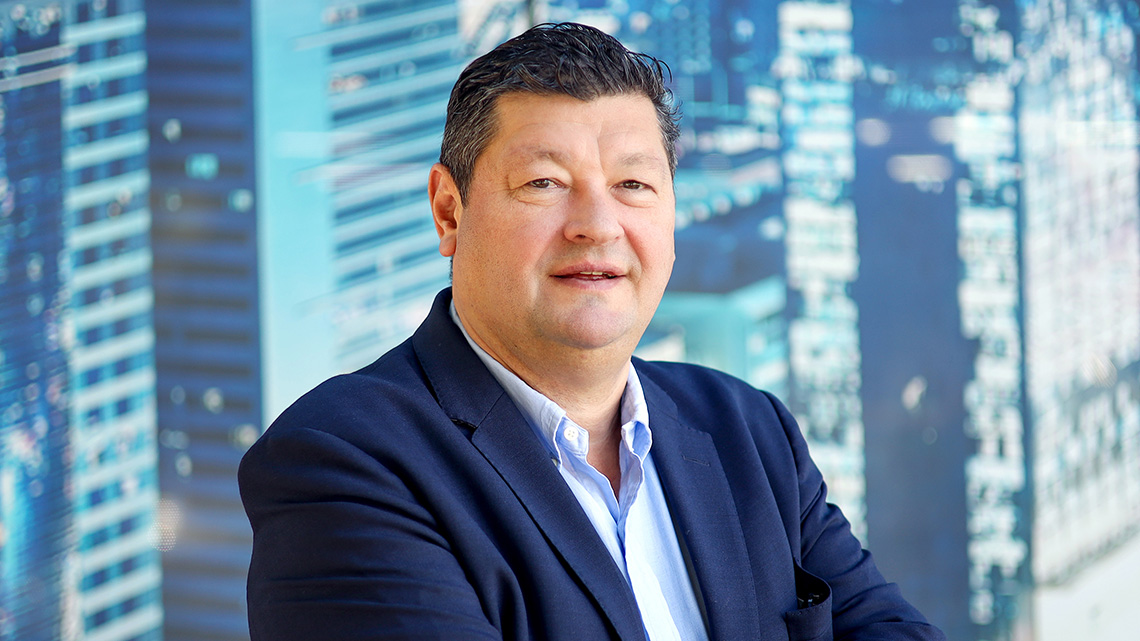
Stephane Fund, Founder and CEO, Trasna
The idea of a fully connected world has been talked about for years, often in sweeping projections about billions, even trillions, of devices coming online. But beneath that optimism sits a quieter reality: the infrastructure needed to support such scale is still fragmented, expensive, and difficult to manage. For device makers and network operators alike, building and deploying connected devices still involves navigating multiple vendors across chip design, connectivity, and device management, each operating independently. The result is higher costs, longer deployment cycles, and systems that are difficult to scale.
It’s within this complexity that Stephane Fund has spent much of his career working. With over three decades in software and telecommunications, he has consistently focused on simplifying the systems that underpin mobile connectivity, developing a close understanding of where they fall short, particularly when it comes to integration and scale. Today, as Founder and CEO of Trasna, he brings that perspective into building a more integrated approach to IoT, driving the company’s evolution as a fully integrated global IoT innovator.
A Journey shaped by Experience
Long before founding Trasna, Stephane had already established himself as a seasoned entrepreneur with a strong track record of building and scaling several technology ventures across mobile connectivity, security, and telecommunications. He went on to found and lead several companies in the mobile and SIM technology space, many of which were later acquired by larger industry players. Among his most notable ventures was Simulity Labs, a company specialising in SIM and eSIM security, which was acquired by Arm in 2017. Prior to that, he co-founded Bantry Technologies, later acquired by Trusted Logic (Gemalto), and founded Mi-Sphere, a mobile applications company that was acquired by Zamano. These experiences not only sharpened his technical expertise but also gave him a deep understanding of the mobile connectivity ecosystem, an understanding that later became foundational to Trasna’s vision.
The Genesis of Trasna
In 2018, following the acquisition of his previous company by Arm, Stéphane turned his attention to the next phase of connected technologies. The IoT market was expanding rapidly, with billions of devices coming online, yet the underlying infrastructure remained fragmented and difficult to scale. The potential of IoT was clear, but so were the underlying challenges. For device makers and network operators, high costs, slow implementation cycles, and a reliance on multiple vendors continued to limit efficiency. Within this complexity, Stéphane recognised the need for a more cohesive foundation for IoT, one that could simplify how connected systems are designed, deployed, and managed. This led to the founding of Trasna, a global technology company built to harness the potential of semiconductor and mobile technologies to shape the future of IoT.The name itself—“Trasna,” meaning “to go across” in Irish—reflects this vision of bridging gaps across technologies, systems, and markets, delivering transformative experiences for mass IoT adoption.
Today, Trasna stands as a global force with a presence across four continents. Headquartered in Ireland, it has established innovation hubs across France, Italy, Dubai, India, and Tunisia, alongside GSMA-certified production facilities in Dubai and Bosnia. Trusted by over 250 brands across more than 80 countries, the company delivers end-to-end IoT cellular connectivity solutions from core processors to microcontrollers, SIM, eSIM, and iSIM/SoC technologies, cellular IoT modules, and device management platforms.“Clients choose Trasna for its strong technical expertise and integrated chip-to-cloud capabilities, enabling greater control, efficiency, and innovation. By partnering with us, they unlock maximum value and a lasting competitive edge,” asserts Stephane.
Building an Integrated IoT Ecosystem
In its early years, Trasna focused on building out its core capabilities. The company began by strengthening its expertise across hardware and software through targeted acquisitions, including Elatec in Germany and SAFE-IoT in France. These additions brought in technical depth and helped establish a base for more integrated development. This was followed by a growing emphasis on in-house innovation. In 2023, Trasna reached a key milestone with the launch of its first SIM chip and its own RISC-V core processor.
The momentum continued in 2024 with the acquisition of Workz, a leader in cloud eSIM technology, and the integration of IoTerop, a specialist in device management. These additions strengthened Trasna’s full-stack solution, bringing it closer to its vision of full vertical integration – chip to cloud. Meanwhile, to support its expanding ambitions, Trasna established a semiconductor-focused R&D and manufacturing facility in Kerala, India. It further strengthened its capabilities in early 2025 with the agreement about u-blox’s cellular IoT module business, extending its reach across LTE-M, NB-IoT, and Cat 1 modules while reinforcing its position across key industry verticals.
Navigating Challenges with Strategic Discipline
Alongside its product development, Trasna has also focused on strengthening the reliability and security of its technology. While broader semiconductor shortages have affected parts of the industry, the company has seen relatively limited disruption. “Chips in SIM cards are less complex than those in high-end electronics, which have faced more of the ripple effects of the broader shortage. Trasna has not seen much disruption as it strategically manages chip production challenges by securing multi-sourcing agreements with foundries and prioritising supply chain resilience,” explains Stephane. This strategic approach, supported by strong partnerships, has enabled the company to maintain a steady flow of products, while demand for its SIM chips remains strong, supported by ongoing investments in 5G and IoT.
Leadership Grounded in Strategic Clarity and Trust
Stephane’s leadership style reflects a balance of deep technical expertise and a clear strategic vision. Having built and scaled multiple ventures over the years, he brings a measured, steady approach to decision-making, one that values clarity over complexity and consistency over short-term wins. At Trasna, this translates into a culture that emphasises accountability and ownership. Teams are encouraged to take initiative, guided by a clear sense of direction that allows them to act with confidence while staying aligned with the company’s broader goals.
Stephane also places strong emphasis on partnerships, collaboration, and agility—qualities that have strengthened Trasna’s position in a competitive market. His perspective on emerging technologies is equally pragmatic. While acknowledging that adoption cycles such as those for eSIM can take longer than expected, he remains confident in their long-term impact. For Stephane, the key lies in building solutions that are not only innovative but also practical, scalable, and aligned with real-world customer needs. As he puts it, “The core of my mission is to deliver mobile technology that elevates business efficiency and security, ensuring customer satisfaction through continuous innovation and collaboration.”
Powering the Next Era of Connectivity
Moving ahead, Trasna continues to build on its existing capabilities while expanding its product portfolio across SIM, eSIM, and integrated SoC solutions. These three approaches are expected to coexist for the foreseeable future, each serving different use cases and requiring parallel development. Across all three, the core function remains the same—enabling connectivity—while giving customers the flexibility to choose what best fits their needs.
The company is also advancing secure SIM technologies aligned with next-generation networks such as 5G and NB-IoT, alongside ongoing innovation in semiconductor design and embedded systems. At the same time, Trasna is strengthening its presence across Europe, North America, and Asia, with India emerging as a key growth market. With a growing global footprint, a rapidly evolving product portfolio, and a clear strategic vision, the company is well on its way to becoming a leading force in cellular IoT.
For Stephane, however, the journey is far from complete. With ongoing investments in next-generation technologies, expanding operations in high-growth regions such as India and APAC, and a continued focus on end-to-end integration, his ambition is clear: to build the infrastructure that will power the next era of global connectivity. In doing so, he is not just leading a company; he is helping to shape the very foundation of a more intelligent, connected world.