
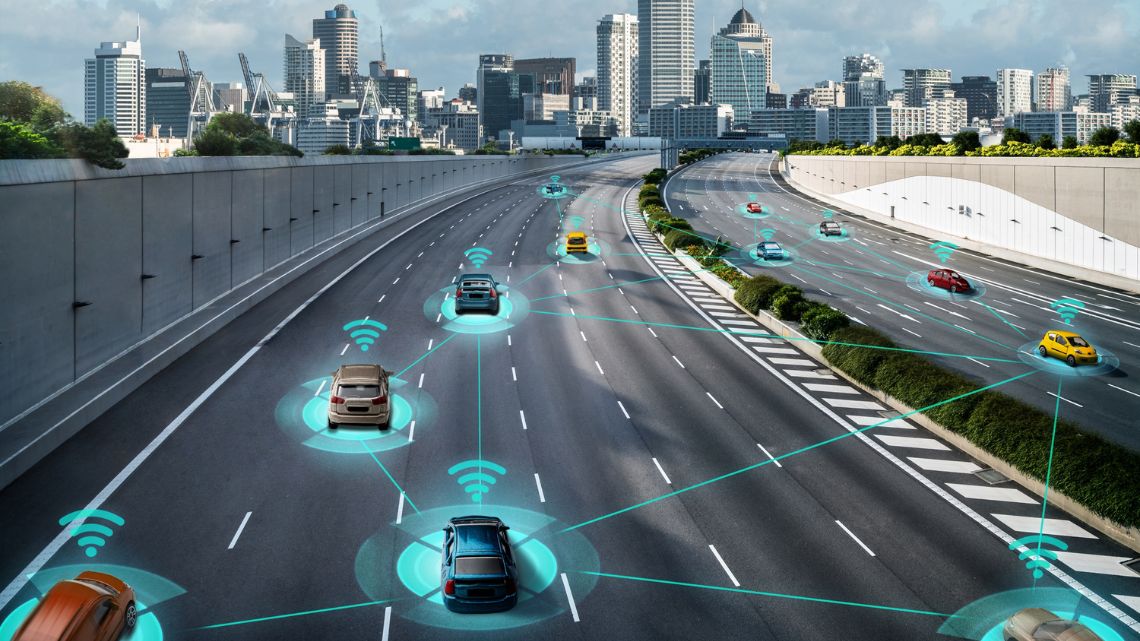
The city of Riyadh is still fast asleep, and the shaded boulevard hums the promise of movement. Way up on the 17th floor of a blue sky-rise, Zohra walks the marble floors, her laptop in hand and spectacles perched on her head. As an urban systems engineer for 11 years now, she has come a long way since the first autonomous shuttle glided across the King Abdullah Financial District.
Being an early bird, Zohra starts her mornings here with a compulsory black coffee, taking in the stillness of the dawn before the chaos returns and the city starts speaking its digital language again. Growing up in a small town near Al-Ula, she remembers what the infrastructure looked like at the time: dusty roads, long queues for buses that came when they could, and the idea of a “smart city” like something found only in textbooks. But now, as she helps shape mobility systems with her colleagues, that may one day stretch from Riyadh’s busiest intersections to remote desert villages, she feels the contrast with every project opportunity. “If we can only move people better, we can surely move opportunity,” she says. Her sentiment mirrors the Gulf’s momentum, as the region no longer just constructs buildings but a future that sustains.
Where the Gulf’s Smart City Ambitions Stand Today
Across the GCC, governments continue to invest heavily in smart infrastructure initiatives. According to the Saudi Ministry of Communications and Information Technology, Saudi Arabia has expanded its smart city agenda under Vision 2030, channeling over $500 billion into NEOM as its future-city model. Moreover, the UAE moves forward with its own Smart Mobility Strategy, which Dubai’s Roads and Transport Authority (RTA) states aims to make 25% of all trips autonomous by 2030.
These are real projects and systems, shaping how people work, commute, and live. All the way from Bahrain’s digital government platforms up to Qatar’s AI-driven traffic management systems, the Gulf is slowly but surely stitching together a region-wide ecosystem.
Urban Mobility is Getting Smarter
In cities like Dubai and Doha, mobility initiatives now combine both sustainability and technology instead of treating them as two separate pursuits. Today, Dubai’s RTA records significant progress in smart traffic systems that reduce congestion and improve fuel efficiency, while Abu Dhabi expands electric charging networks through its Smart Mobility Program.
Having said that, the most interesting shift actually comes from hybrid mobility planning: designing for electric buses, micro-mobility, autonomous taxis, and pedestrian-friendly walkability at the same time.
Like Zohra, many urban systems engineers spend their afternoons going over thousands of data points from pilot routes. They see the analytics in real time, but what excites them the most is what lies beyond the numbers: families using transit at hours they previously avoided, older residents navigating stations with ease, workers saving precious minutes during peak hours. Zohra believes that this is when a city stops being a place and finally becomes a partner.
Connecting Remote Regions
Smart mobility in the Gulf isn’t confined to city centers alone. Across Saudi Arabia and the UAE, leaders join together and aim to connect rural towns more seamlessly with economic hubs. According to Oman’s Ministry of Transport, the country’s Integrated Transport System now includes a smart corridor planning to link remote industrial zones with coastal cities. Similarly, Saudi Arabia’s NEOM region, which lies deep in the Tabuk desert, is building entire districts around autonomous-first design. According to NEOM’s official project updates, The Line will operate without carbon emissions, streets, or cars, like an unprecedented model that rural and urban communities could replicate on smaller scales.
Zohra recalls visiting her hometown just last winter in 2024, watching survey drones map a route that could someday replace the single-lane, dusty road she once travelled daily to college. It’s almost surreal. The future came looking for us,” she says, laughing.
Testing, Scaling, Governing
Today, the Gulf positions itself as one of the world’s leading autonomous testing grounds. Dubai’s partnership with Cruise, as announced by the RTA way back in 2021, marked the region’s first step toward operating a commercial autonomous taxi fleet. Meanwhile, Doha has already piloted autonomous shuttles in preparation for major global events. And in Saudi Arabia’s expansive megaprojects, autonomous mobility integration starts from day one, because in the Gulf, autonomy is not an experiment but core infrastructure.
A Future in Full Swing
Smart cities have stopped being mere concept sketches that are found in textbooks; they are now lived-in environments evolving every month. Urban mobility in the Gulf today is a growth driver for accessibility, economic diversification, and sustainability.
As Zohra stands by the ceiling-high window panes, watching the traffic increase below, she only thinks of all the young engineers who will inherit these systems. Of families who will one day travel across the region with greater ease and of rural towns slowly pulling closer to opportunity. She takes one last swig of her black coffee and hums to herself before heading toward the conference room, her Sustainable Water Management Design portfolio in hand. “Technology isn’t the priority; movement is. And everyone deserves complete access to it,” she thinks aloud. The Gulf’s story of smart cities and mobility is still being written today. And for the first time in forever, it moves at the speed of real possibility.
For more articles, visit Entrepreneur Gulf.
Connect with Us:
LinkedIn: https://www.linkedin.com/company/entrepreneur-gulf/
Twitter X: https://x.com/entpre_gulf
Instagram: https://www.instagram.com/entrepreneurgulf/