
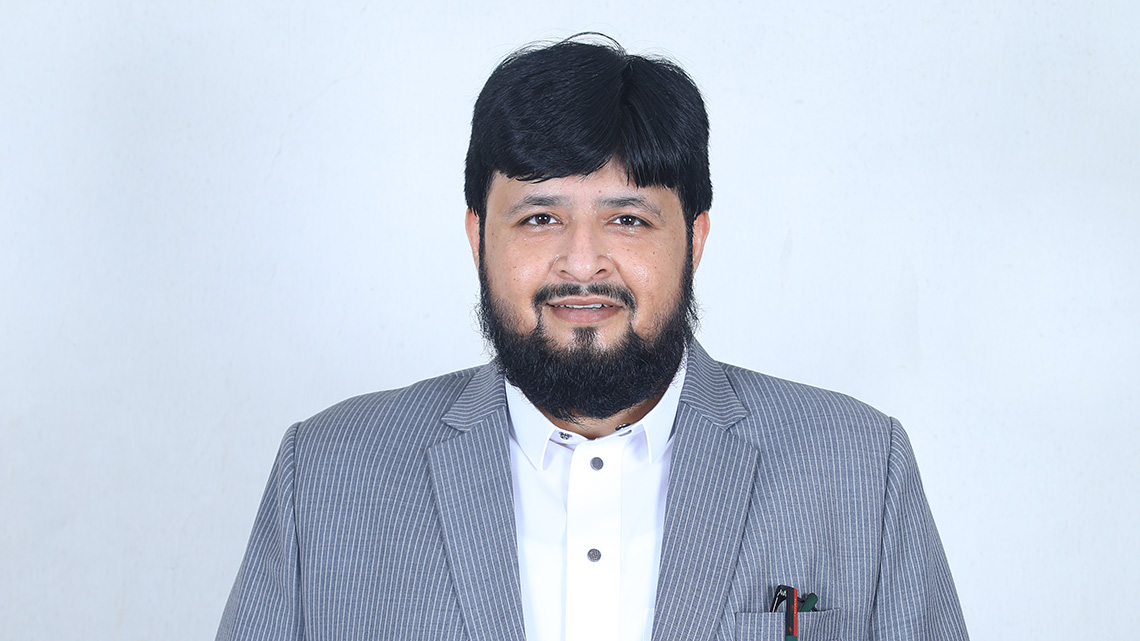
Mohammed Junaid, CEO, Helix Arabia Group
The most consequential businesses are rarely born from a perfectly mapped plan, they emerge in the interstices between what exists and what could work better. Entrepreneurship begins with a certain restlessness, the refusal to accept inefficiencies, fragmented solutions, or familiar ways of doing things when there is scope to build something more cohesive and consequential. Over time, that instinct can turn isolated gaps into interconnected possibilities, creating businesses that do more than serve a market; they reshape how value moves through it.
That instinct to turn fragmented needs into connected possibilities finds its expression in Mohammed Junaid, CEO of Helix Arabia Group, whose entrepreneurial approach has been shaped by a consequential question, if a business could solve more than the problem it was originally called to solve. For Junaid, entrepreneurship has never been about building a collection of services for the sake of scale; it is about creating a constellation in which each capability strengthens another. What began with an eye for operational gaps evolved into a broader vision of business as an ecosystem, bringing together logistics, transportation, technology, manpower, procurement, and other complementary capabilities rather than allowing them to operate in silos. Within that ecosystem, Three Miles Transportation Company represents an important extension of Helix Arabia Group’s ability to address the movement and operational needs that sit at the heart of modern business.
There is a pragmatism to that philosophy. Instead of treating complexity as something to be managed from a distance, Junaid sees it as something worth understanding at its source. “A business should not simply provide an answer, it should make the next problem easier to solve,” shares Junaid. That principle captures the thinking behind Helix Arabia Group’s evolution, staying close to clients’ realities while remaining agile enough to respond as those realities change. The result is an entrepreneurial model built less on breadth for its own sake and more on connectedness, adaptability, and purposeful execution.
The Architecture of Adaptation
Growth hardly ever comes without leaving a few dents along the way. For Junaid, every stage of building Helix Arabia Group brought a different test, beginning with the need to earn market credibility and moving into the far more intricate demands of expansion. The answer was never to make grand claims, but to start modestly, over-deliver, and let the work become its own proof. As the business widened into IT, manpower, trading, and transportation through Three Miles Transportation Company, the challenge shifted from gaining ground to holding it together. What could have become a collection of disconnected businesses was instead shaped into one ecosystem, bound by shared standards and an integrated way of working.
At scale, complexity brought its own reckonings, compliance, cash flow, and the unrelenting need to maintain quality across different verticals. It reinforced a lesson Junaid carries into leadership: “Challenges do not disappear, they change shape,” states Junaid. Strong SOPs, early leadership, and a willingness to learn quickly became essential rather than optional. His leadership philosophy follows the same thread, build people, and they build the business. Accountability, integrity, and agility with empathy form its bedrock. He expects the Helix name to carry the same standard across every service, values long-term trust over short-term gains, and believes speed must never come at the cost of people. As CEO, his role is to set direction, clear obstacles, and create enough trust for teams to take risks, own outcomes, and move together. In that kind of culture, growth becomes less something a leader commands and more something people collectively create.
The Machinery Behind Momentum
Growth may look glamorous from the outside, but its real test is often found in the machinery no one sees. For Junaid, keeping expansion from becoming unwieldy comes down to discipline, the deliberate work of making consistency possible even as the business grows in scale and scope. Standardisation provides the backbone, with common SOPs, KPIs, and a shared brand promise ensuring that every vertical moves to the same measure of quality. Technology adds another layer of visibility, with dashboards and tracking systems helping teams identify when something begins to drift rather than discovering it after the damage is done.
Yet systems alone cannot carry a growing organisation. Culture has to hold the centre. Junaid emphasises the idea of “One Helix,” where employees look beyond the boundaries of their own departments and recognise that every role ultimately shapes the customer experience. He reflects, “Growth is exciting, but reputation is unforgiving.” That conviction keeps ambition tethered to readiness. The philosophy is exacting: growth should never outrun the systems, people, or standards designed to sustain it. In the long run, restraint is not the enemy of ambition, it is what gives ambition staying power.
Future Belongs to the Builders
The next chapter for Helix Arabia Group is not just about becoming bigger; it is about becoming more consequential. Over the next five to ten years, the ambition is to evolve from a diversified services company into a technology-enabled solutions group, guided by three priorities, innovation, expansion, and sustainability. Digital platforms will bring its verticals closer together, connecting logistics, transportation through Three Miles Transportation Company, manpower, and procurement through a more integrated client experience. Three Miles Transportation Company adds another dimension to this ecosystem, strengthening Helix Arabia Group’s transportation capabilities while reflecting the broader philosophy behind the group: building complementary businesses that create greater value when they work together. Growth will deepen across KSA and the wider GCC before extending selectively into Southeast Asia and Europe, with new markets entered only when the same quality can travel with the business. At the same time, greener fleets, paperless processes, and stronger workforce welfare will place sustainability closer to the core of operations.
Yet Junaid’s vision extends beyond the company itself. He states, “Impact comes before income.” It is a philosophy rooted in solving real problems, executing with rigour, and building trust rather than chasing quick wins. His message to emerging founders is equally candid: perfect conditions rarely arrive. Start, learn, adapt, and keep moving. For the next generation across KSA and the region, he sees Vision 2030 as fertile ground for enterprise, and believes the future will belong to those willing to build it, not merely wait for it.