
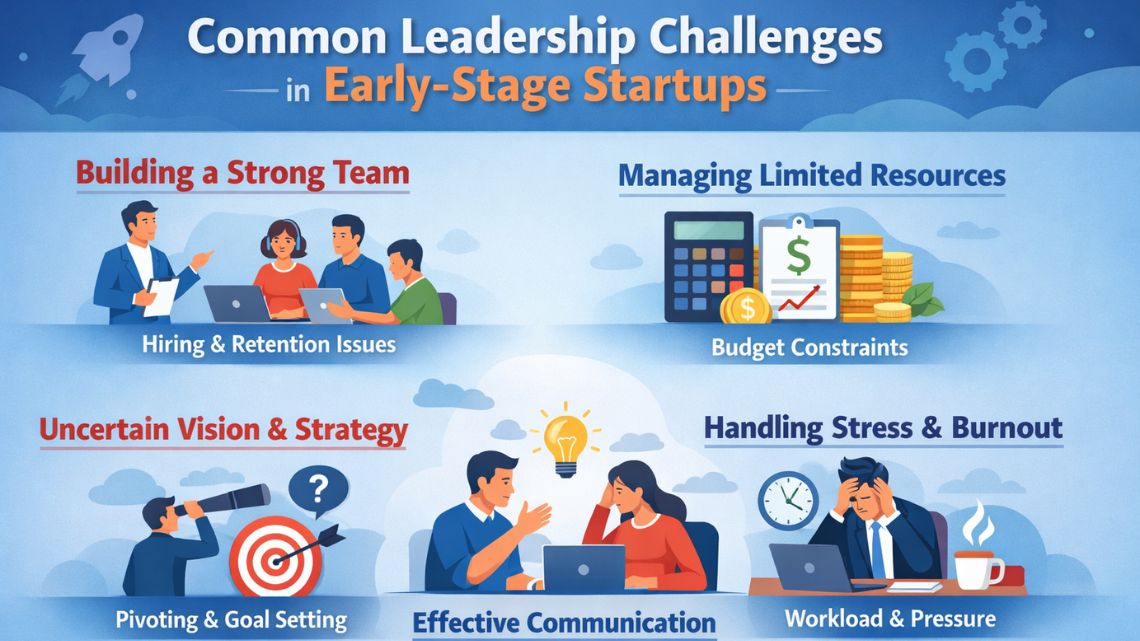
Startups in the early stages typically operate in highly uncertain environments where resources remain constrained as growth expectations accelerate. In the Gulf region, where ambitious national visions, digital transformation goals and access to global capital converge in support, startups can rapidly grow if internal leadership capabilities are mature. In the context of unprecedented market shifts in this region marks leadership as a crucial determinant of organizational success.
Strong leadership is the key to overcome obstacles and successfully translate a leader’s vision into reality. This blog describes the most common leadership challenges faced by early stage startups, offering a clear and practical perspective for founders and startup entrepreneurs to manifest enduring ventures.
What are the Early-Stage Leadership Challenges in Startups
Early stage founders and leaders face intense challenges due to constraints of resources, untested business models, and decision making pressure under ambiguity. Uncovering how leaders can navigate these challenges with practical, execution focused strategies.
- Transitioning from Visionary to Operator
Startup entrepreneurs are typically visionaries, but the transition to becoming a system oriented leader is quite challenging. To develop a high performing team, leaders need to effectively illustrate the mission and inspire early momentum. As a startup grows, evolving into operational discipline will be a pivotal factor for success. Especially when operating in a fastly developing economies like the Gulf, leaders must develop proficiency in process ownership and execution and performance management beyond ideation.
Codify strategies and mission, invest in building scalable strategies prevents problems in the future rather than emphasising on short term stability.
- Decision-Making Under Ambiguity
Amid the competition with tech giants, global industry leaders, decision making under uncertainty is one of the crucial challenges for startup leaders. As the market is constantly shifting with unclear data, customer behaviors, and rising expectations, developing a leadership framework that enables risk aware decision making without compromising on speed will be pivotal. This helps leaders prevent reactive responses based on assumptions and guess work and anchor small, testable steps that provide long term outcome insights and prevent any catastrophic actions in the future.
- Building the Right Team with Limited Resources
Attracting and retaining talent continues to be a huge challenge for many early stage companies since they have to compete against large well-established corporations and multinational companies when trying to recruit and maintain skilled workers. Also within the e-Gulf, where companies have diverse and workforces are from multi‑culturally origins, the founders need to acquire knowledge to effectively manage cultural fit while dealing with resource constraints. As such, developing a business strategy model for hiring, implementing flexible roles, and leading through purpose becomes nonnegotiable.
- Establishing Credibility and Trust
In many instances, early stage leaders are required to build credibility with staff, investors, partners, and regulators simultaneously in order achieve sustainable growth. Trust between two individuals or an organization and its various constituents is developed by consistently communicating, making decisions based on ethical practices, and delivering their commitments. Credibility of gulf entrepreneurs holds a significant role in establishing and developing long lasting relationships and creating access to potential customers, partners, and potential connections that support your business.
- Managing Rapid Change and Constant Pivots
Startups do not always take a linear path when it comes to growing their business. For example, business models, go-to-market strategies, and the product features currently leading in the market are adjusted constantly based on feedback received from customers and if required transforms their business models and products for competitive advantage. As a result, as an early stage leader, you are responsible for continuously leading your team through the facets of change without influencing burnouts or losing track of how to achieve the company’s goals. It is important that the organization has clear purpose, flexibility, and the ability to sustain teams in alignment with the transitioning priorities of the company.
- Developing Leadership Structure Without Bureaucracy
When a team continues to grow, leadership frameworks that are informal may no longer suffice. However, if the governance practice is unstructured, innovation will be compromised as a result. It is critical for leaders to create governance, accountability for each role and demonstrate a model of decision-making without forcing bureaucracy particularly in the early stages of leadership. A balancing approach is critical in the Gulf where start-ups like Dubai business setup grow at a rapid pace among multiple regions and complexities of revelry, shifting market standards and regulations.
- Communication Gaps in Fast-Growing Teams
The rapid pace of hiring and the geographic dispersion of teams frequently lead to working in misalignment and confusion. Oftentimes, Founders believe that everyone has a shared understanding of the same goals but do not recognize that each of the teams are working from different levels of understanding. Therefore, effective leaders need to utilize clear communication methodologies in order to accomplish shared goals. Leaders should focus on setting clear goals, developing a regular feedback loop and providing complete transparency around their decision processes. By demonstrating an appropriate communication framework, leaders will ensure that their organizations are maintaining alignment as they operate across different geographies and functions.
Conclusion
As the Gulf continues to grow as an opportunity driven landscape, challenges are integral to long term success in the startup business landscape. As witnessing the ongoing transformation, early stage entrepreneurs will face challenges associated with establishing a successful team, developing well thought leadership structure and strategies, providing credibility and decision making under pressure. Founders who invest time and resources dedicated toward developing leadership qualities, technology and finance literacy, and understand the current market will create seamless evolving, impactful and high performing organizations.
For more articles, visit Entrepreneur Gulf.
Connect with Us:
LinkedIn: https://www.linkedin.com/company/entrepreneur-gulf/
Twitter X: https://x.com/entpre_gulf
Instagram: https://www.instagram.com/entrepreneurgulf/