
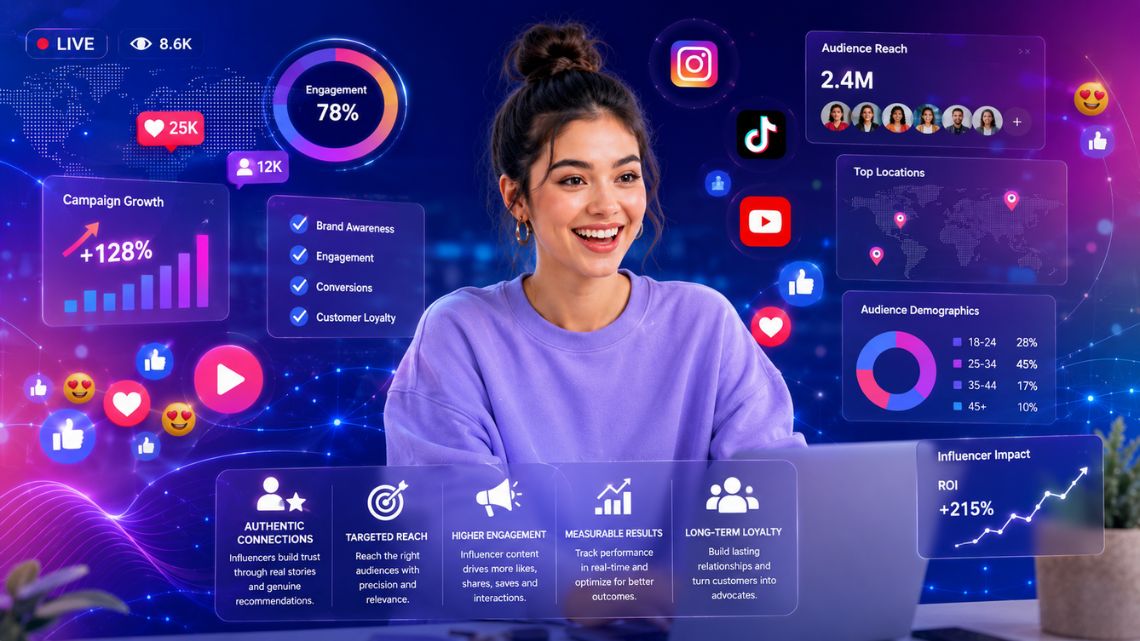
Influencer marketing has emerged as a cornerstone imperative for establishing long-term business viability and market relevance amid the increasing competitive saturation. Especially in the region of the Gulf arena, companies are more likely to trust peer-driven recommendations than a direct social media advertisement. Transitioning into a creator-led marketing ecosystem is substantially a foundational capability for organizations seeking long-term business potential. In response to the enhanced exposure and awareness due to social media, businesses can position influencer marketing as a strategic driver of consumer purchase decisions and loyalty to drive business success at an accelerated pace.
What Is Influencer Marketing
Influencer marketing is a type of social media marketing that involves collaborations between brands and individuals who have the exposure and industry potential to drive marketing success through diverse forms of influence. These influencers are categorized on the basis of niche relevance, audience engagement, and expertise. In the realm of B2B, they vary from industry experts and analysts to CEOs and thought leaders.
In the context of the Gulf business landscape, it includes authoritative creators who influence audiences across the region’s Arabic, English, and multicultural segments through social media channels and networks.
Key categories
Influencers in the business-to-business spectrum are classified as:
- Mega influencers – Regional celebrities and public figures
- Macro-influencers – Large digital personalities with broad reach
- Micro-influencers – Niche experts with high engagement
- Nano-influencers – Community-level trusted voices
Remarkably, the markets of the Gulf landscape show strong engagement capital from micro and nano influencers who focus on trends and new business discovery. The paradigms are shifting from vanity metrics and follower count for performance potential to moving toward audience trust, engagement depth, conversion behavior, narrative-driven authority, and linguistic relevance.
Beyond the model of single-platform orchestration, influencer marketing has emerged into multiplatform e-commerce ecosystems, retail experiences, tourism promotion initiatives, and event-driven marketing strategy. Therefore, this function is no longer an isolated function; it is a comprehensively integrated omnichannel growth ecosystem.
Macro Forces Reshaping Future of Influencer Marketing
- AI-generated content saturation
The increased saturation of AI-generated insights and the penetration of AI assistants have made creating digital environments where authentic human storytelling as a premium asset.
- Algorithmic distribution limiting organic reach
Promotional platforms are featuring paid media for high-priority reach. This decreases the potential of organic content visibility and compels brands to invest in creator-led marketing networks significantly.
- Consumer skepticism toward AI-driven content
Especially in the realm of Gulf business relationships, where trust and reputation and integrity become foremost differentiators, authenticity and reliability are the currency for personal branding and marketing success. Influencers derive a competitive advantage by evoking trust through authentic presence.
- Growth of micro and nano creator ecosystem
Creators who have a strong influence on the local audience can outpace high-end global influencers in building engagement and conversion. Especially in Gulf sectors like women’s fashion, real estate, automotive, and luxury lifestyle, cultural and linguistic alignment is a crucial competency.
- Performance-driven influencer compensation models
Brands are increasingly shifting from fixed payments to:
- Affiliate-based commissions
- Conversion-linked payouts
- Hybrid performance contracts
This paradigm shift quietly shaping a more successful and ROI-driven influencer ecosystems.
Core Architecture of Modern Influencer Marketing Systems
Influencer marketing in the Gulf landscape is revolutionized with more structure and data-informed approaches aligned to the evolving expectations of buyers. This futuristic model comprises four layers:
- Creator Intelligence Layer
AI-based influencer discovery platforms
Demographic and psychological mapping
Fraud detection (fake profiles, engagement manipulation)
Brand-fit scoring systems
- Content Production Layer
Creator-led storytelling frameworks
UGC-style content instead of traditional ads
Localization for the Arabic and Gulf’s multicultural audience
Multi-format content adaptation
- Distribution Layer
Platform-native optimizations
Integration with e-commerce and retail ecosystems
Combined approaches of paid amplification and organic creator-led reach
- Measurement Layer
Conversion tracking and attribution modeling
Brand lift studies and sentiment analysis
ROI tracking beyond impressions and engagement
Customer lifetime value (CLV)-based evaluation
The Future Models of Influencer Marketing
- Performance-First Influencer Economy
Unlike the models of fixed payment ecosystems, the landscape of influencer marketing is transforming into performance-based ecosystems. In this, the commission or compensation will regard directly to the measurable outcome capital such as leads, conversions, rate of engagement, etc.
- Long-Term Creator Ecosystems
Companies are moving beyond short-term campaigns, and more focused on building:
- Always-on creator partnerships
- Ambassador programs
- Integrated brand creator communities
This ennables sustained brand presence and compounding trust.
- AI-Augmented Influencer Systems
AI is increasingly used for:
- Predicting campaign performance
- Matching brands with optimal creators
- Optimizing content formats
- Automating performance reporting
This enables data-led influencer decision-making at scale.
- Awareness to Behavioral Influence
The focus is shifting from visibility to behavioral change, including:
- Purchase intent generation
- App downloads
- Store visits
- Subscription conversions
Decision is the primary determiner of influence rather than merely awareness.
- Privacy-first and trust-centric marketing ecosystems
In a highly digital-driven era, the consumers and decision makers are aware beyond the technical aspect but changing regulations, it’s integral for brands to transition toward first-party data, consent-driven engagement, and trust-first creator relationships. The Gulf markets are highly regulated; therefore, it’s necessary for brands to heighten their reputation and credibility in order to sustain themselves as an authority in the highly saturated market.
Conclusion
The incorporation of influencer marketing has become substantially an important methodology of futuristic brand promotion within the digital economy. Particularly in the gulf landscape, community engagement, meaningful relationships and authenticity driven trust are the core strategies to identify influencers, identify creators who has strong relationship with your niche audience, implement AI to enhance content marketing effectiveness, and capitalize on cultural relevance to create evoking storytelling. Businesses that successfully converge these strategies will create enduring growth for the future.
For more articles, visit Entrepreneur Gulf.
Connect with Us:
LinkedIn: https://www.linkedin.com/company/entrepreneur-gulf/
Twitter X: https://x.com/entpre_gulf
Instagram: https://www.instagram.com/entrepreneurgulf/