
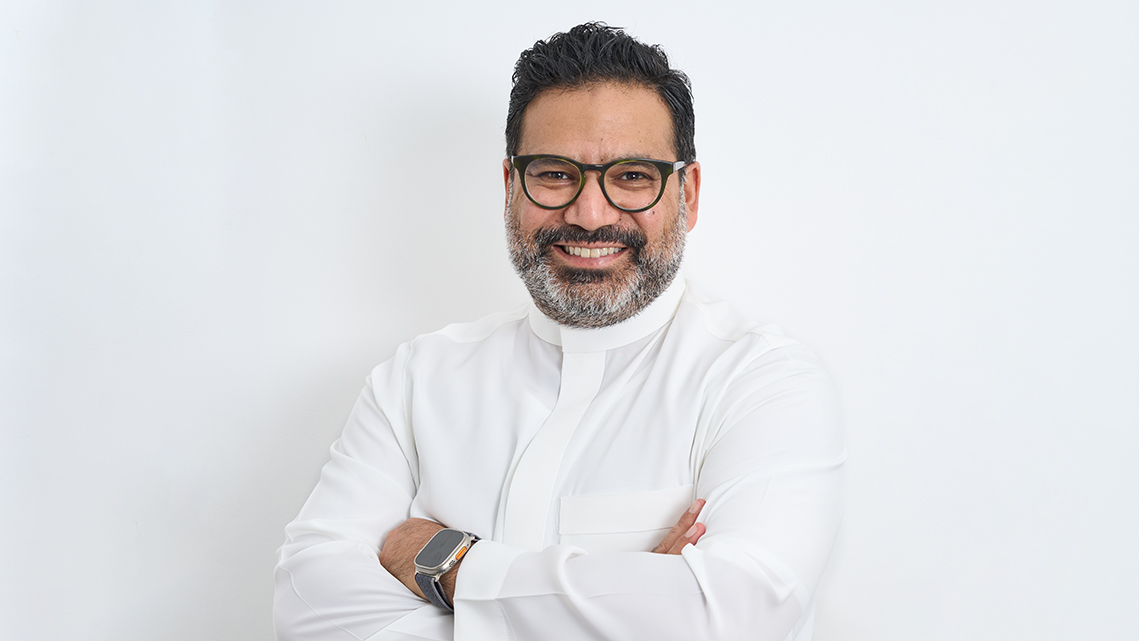
Ahmed Zaidan, Founder, EdgeArch
In the quiet focus of a childhood workshop, a young boy meticulously took apart a mechanical toy. To a casual observer, it might have looked like an act of curiosity, but for Ahmed Zaidan, it was a search for logic. He spent his early years building model cars and planes, eventually experimenting with small electric motors and converting them to solar power. For Zaidan, the world was never just a collection of finished objects; it was a series of systems waiting to be understood, improved, and reimagined. This innate fascination with how things ‘fit together’ would eventually lead him to found Ahmed Zaidan Architects & Engineers, which he later named EdgeArch, a firm that has become a cornerstone of architectural excellence in Saudi Arabia.
At the Crossroad of Art and Technology
Zaidan’s journey was born at a unique ‘crossroad’ between a natural aptitude for engineering and a deep passion for the arts—drawing, painting, calligraphy, and music. He chose architecture as his medium, seeing it as the perfect fusion of these two worlds. His pursuit of excellence took him to Pratt Institute in New York City, where he began to sharpen a vision that differed from many of his peers. While others dreamed of designing private homes, Zaidan was captivated by the idea of societal impact.
His early career in New York solidified this conviction. Working with the late Rafael Viñoly, one of the star architects of his time, he contributed to major public projects such as the David Lawrence Convention Centre and the Howard Hughes Institute. Later, at RBSD Architects, a 100-year-old healthcare design firm, he mastered the ‘encompassing approach’ of healthcare design, learning that a hospital’s beauty is as important as the complex medical operations required to save lives, reduce medical errors, and staff fatigue. It had to be a healing environment for both patient and practitioner.
The Leap and the ‘Fax’ that Changed Everything
In 2004, driven by a lifelong passion for entrepreneurship, Zaidan returned to Saudi Arabia to found his practice. The transition was a trial by fire; architecture school had not prepared him for the ‘hard work’ of marketing, sales, and financial management. The greatest challenge in those early years was not delivering the design but scaling, management, finance, and maintaining a consistent flow of clients in a cyclical industry. Issues an entrepreneur faces that were never taught in design schools.
The defining moment for the firm arrived in 2010 via a fax. It was an invitation to tender for the new King Abdullah Airport in Jizan. Initially believing it was a mistake due to the firm’s small size and lack of experience in airport planning and design, Zaidan called the authorities, offering to return the invitation letter, only to be told he was on the shortlist because of a unified consultant list, an absolute serendipity. With the encouragement of Eng. Talal Bakadi, the person in charge of the project at the General Authority of Civil Aviation and Eng. Mohammed Mashat, the retired head of Engineering at the Authority who had believed in him and put his name on the shortlist, Zaidan embraced a strategy that would become his hallmark: collaboration over scale. By forming and leading a consortium with international experts, his young firm successfully delivered a major international airport, proving that leadership is about managing expertise rather than just accumulating staff, and success is a group endeavor rather than a singular genius.
The Ethical Blueprint: Leading with Substance
As the firm grew, eventually winning over 13 international design awards, Zaidan’s leadership style evolved from an intensely ‘hands-on’ approach in his 30s to a model of trust and delegation in his 50s. Central to his philosophy is a commitment to ethical employment. While many firms follow a ‘hiring and firing’ cycle based on project volume, Zaidan maintains a core medium-sized team and scales through collaboration. He refuses to treat talent as a disposable resource, ensuring he doesn’t make people redundant during down cycles.
This success was further fueled by a fortunate era in Saudi education, as he tapped into a rising pool of exceptional female and male graduates in design and engineering. Zaidan also learned from the challenges; a studio opened in Rome to tap the global talent market taught him that every market is unique, leading him to refocus that team to service Saudi clients more effectively.
Redefining the Marker of Success
For many, success is measured in revenue. For Ahmed Zaidan, the true measure was found two years ago at a wedding dinner for a former architect. Surrounded by former employees—many of whom had gone on to start their own firms or hold high-ranking positions—he listened as they credited EdgeArch for their professional foundations, and relayed stories and accolades of their experience working with him.
“Your success is not how much money you’ve made or how many projects you’ve done,” Zaidan reflects. “Your success is how much you’ve impacted the lives and careers of the people who came and worked in my company.”
The Road Ahead: Strategy and Freedom
Looking toward the future, Zaidan is strategically pivoting EdgeArch toward the private institutional sector and real estate developers. He remains a serial entrepreneur, launching Williams New York Middle East for luxury real estate branding with its original founder David Williams from New York, and exploring a startup in an Arab world focused online platform for art after a successful five-year partnership in one of the regions prominent art galleries, Athr, and contemplating rebranding his firm from EdgeArch to ZAE to begin a new chapter with new ideas and goals. Yet, he has also found balance; when he needs to ‘blow off steam,’ he takes to the open road on his motorcycle, riding until he can’t ride anymore—a testament to his ongoing need for both movement and reflection.
His advice to the next generation is clear: Decide early what success means to you, and have the mindset to keep going when things look their worst. Ahmed Zaidan’s story is a reminder that the most enduring structures are not built of stone, but of the values and human potential fostered along the way.