
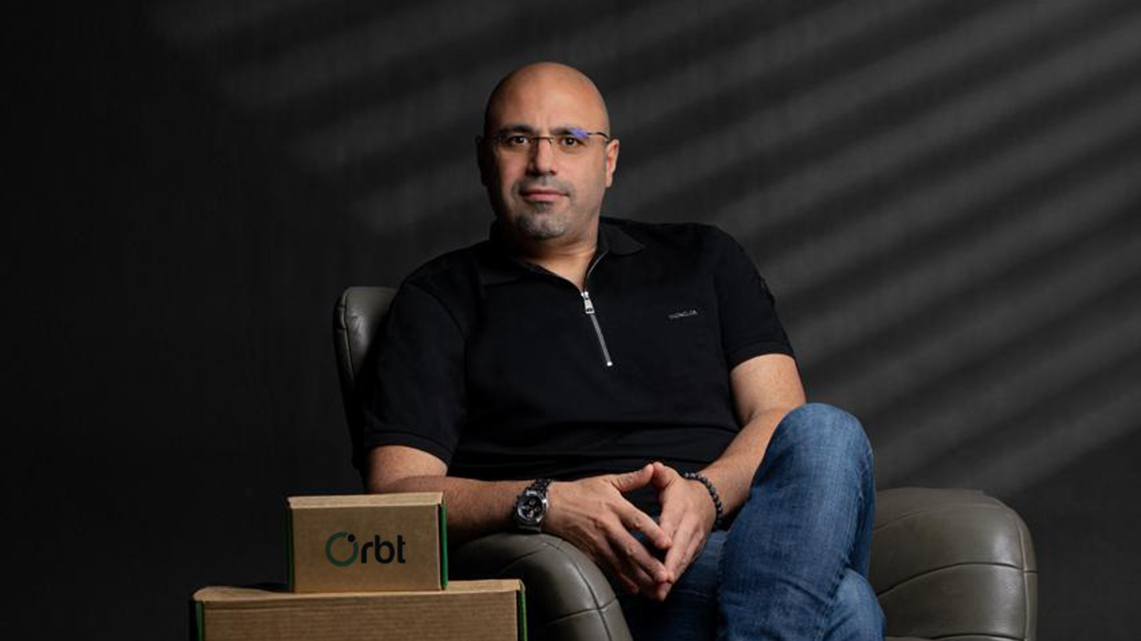
Mohammed Sleiman, CEO, Basatne MENA
We live in an era obsessed with the “new,” but Mohammed Sleiman made his career studying the aftermath – digging deeper into the quiet graveyard of devices and data that the global economy leaves in its wake.
From his vantage point inside Amazon’s reverse logistics operations, he watched millions of devices flow backward into a system never designed to receive them. Returns arrived daily. Most devices had nothing wrong with them. Yet the infrastructure to put them back into motion simply did not exist.
That gap between return and reintegration, became his starting point.
For Mohammed Sleiman, the CEO of Basatne MENA, obsolescence is not the endgame. It’s the inherent architectural fault. And at a moment when technology outlives its perceived usefulness and begins to fade into irrelevance, a different idea took hold: instilling life in the appliance after first use. Where impact dissolved, renewal took shape.
Learning Inside Scale
From global technology organizations to high-growth regional markets, Sleiman has spent two decades observing how value moves: where it compounds, where it leaks, and where it quietly disappears.
A computer science graduate by training, Sleiman’s early career unfolded inside some of the world’s most operationally complex environments. At Hewlett-Packard and Western Union, and later at Amazon, he worked at the intersection of technology, operations, and consumer behaviour, where scale is unforgiving, and inefficiency carries a cost.
“Working across complex and fast-evolving regional markets significantly shaped my entrepreneurial mindset,” he explains. “I was involved in major industry transitions, from physical cash remittances to digitally integrated payment platforms, and from brick-and-mortar retail to scalable e-commerce ecosystems.”
What stayed with him was not the pace of change, but its underlying architecture. Technology alone did not create transformation. Infrastructure did. Business models evolved only when operations, data, and incentives moved in the same direction.
The Problem After the Sale
That insight crystallized during the time he was leading after-market services at Amazon. As device upgrade cycles accelerated and returns increased, the system revealed a critical gap: everything worked well until the first use. After that, there is no point of return. Structure dissolved.
“We consistently faced one major challenge: the lack of a structured, scalable reverse supply chain,” Sleiman recalls.
Products moved efficiently toward consumers, but struggled to find their way back into the economy. The reverse side of commerce – returns, refurbishment, and resale- remained fragmented. Data vanished. Devices lost value prematurely. Environmental cost accumulated quietly, outside the line of sight of most balance sheets.
At the same time, consumer behaviour was shifting. Affordability mattered. Brands were undergoing pressure to demonstrate credible ESG commitments. The Middle East was rapidly adopting digital consumption, yet the lifecycle of electronics remained inefficient and largely informal.
Sleiman recognized a structural demand gap that existed on all sides, but no integrated system was available to connect them.
Cartlow as the Structural Shift
In 2019, he launched Cartlow to address that gap. From the outset, it appeared as a re-commerce platform. Internally, it was something much deeper: a controlled environment to build trust through operations.
Diagnostics were built from the ground up. Refurbishment protocols were engineered for consistency. Warranties were formalized. Logistics were integrated. Lifecycle transparency was embedded into the system itself.
Together, these elements transformed a fragmented marketplace into a predictable, accountable, and scalable circular infrastructure.
“Consumers needed confidence that refurbished devices could deliver reliability comparable to new products,” Sleiman says. “Trust is built through consistency, and consistency requires infrastructure.”
That operational maturity laid the groundwork for the next phase of evolution. Basatne emerged as the larger platform connecting logistics, refurbishment, trade-in systems, fintech payouts, and ESG intelligence into a unified, single closed-loop ecosystem. Devices are traded in, refurbished, resold, tracked, and reintegrated. Value does not leak. Data does not disappear. Impact becomes measurable.
The shift marked a move from execution to enablement.
“I wasn’t interested in building isolated products,” he shares. “I wanted to architect integrated ecosystems that address structural challenges at scale.”
Basatne: Building the Closed-Loop Infrastructure
What began with Cartlow as a B2B e-commerce platform gradually evolved into a broader infrastructure vision. Under Basatne, this vision has taken shape as a fully integrated closed-loop ecosystem connecting every stage of the device lifecycle. Operational capabilities are anchored under Ardroid, which manages diagnostics, refurbishment, and reverse logistics at scale. Cartlow Wholesale enables structured secondary distribution across regional and global markets, ensuring that recovered devices quickly find their next point of use. At the consumer level, Cartlow.com allows individuals to directly circulate devices back into the economy while providing buyers with trusted access to quality refurbished products.
Through TechBridge, Basatne extends this infrastructure to telecom operators and large enterprises, combining circular operations with device lifecycle management to deliver comprehensive circularity programs for telecom providers. More recently, the ecosystem expanded further through Yellowstone, empowering the distribution vision of devices becoming truly circular by strengthening subscription-driven distribution capabilities. At the intelligence layer, Informed introduces ESG data capabilities that convert lifecycle activity into measurable sustainability insights.
Together, these components form one of the region’s most mature circular technology ecosystems designed not as isolated businesses, but as a unified infrastructure where operations, commerce, distribution, and data continuously reinforce the loop.
“By embedding our fintech platform ORBT.com directly into trade-ins and refunds, we ensure that value remains within structured ecosystems rather than existing as cash,” Sleiman says. “Through ORBT’s digital payout infrastructure, circular participation becomes measurable, aligned, and scalable”
Leadership Built for Durability
Leadership, for Sleiman, is less about visibility and more about durability. Having navigated both startups and multinational environments, he emphasizes clarity, execution discipline, and empowered teams. Growth is measured not only in market expansion but in operational maturity.
Partnerships are central to this approach. Circular commerce cannot be vertically owned; it must be collaboratively built. Telecoms, retailers, logistics providers, and technology platforms must connect into a single workflow.
Under his leadership, Basatne has already recirculated more than 500,000 devices across markets, with millions enabled through its wider ecosystem. The significance of that number is not symbolic. It demonstrates that circular models can generate consistent commercial returns while reducing waste and extending product life. In Basatne’s model, profitability and sustainability are not competing priorities. They are interdependent outcomes of well-designed systems.
Recognition has followed, including being named by Fast Company as one of the Most Innovative Companies in Clean Tech. But Sleiman remains measured about accolades. Infrastructure, by nature, is meant to disappear into everyday function. If Basatne succeeds, devices will no longer be described as “used” or “discarded.” They will simply remain in motion.
The Long View
“Basatne reflects the progression from building re-commerce whole-sale trade to architecting a global circular infrastructure platform,” Sleiman states. The mission is no longer about moving units. It is about powering the lifecycle management for telecoms, retailers, and brands across markets.
Looking ahead, Sleiman sees circular technology becoming a defining pillar of economic transformation across MENA. Governments are embedding sustainability into policy. Brands are restructuring supply chains. Consumers are adopting more deliberate consumption patterns.
“The region has a unique opportunity to lead globally by building circular infrastructure at scale,” he says. “Not just marketplaces, but platforms that enable lifecycle management, trade, and data intelligence.”
His advice to entrepreneurs reflects the clarity that has enlightened his vision throughout: “Build for impact, but execute with discipline. Solve real structural problems. Think in ecosystems, not standalone products.”
In his office, Sleiman keeps a device that passed through one of his refurbishment lines. It is unremarkable to look at, a standard model, several years old, with minor wear on the casing. But, inside, every component has been tested, graded, and certified. It works as well as the day it was first packaged.
For him, that device is not a product. It is a proof of concept. Value does not expire. We just need to rebuild the infrastructure to preserve it.